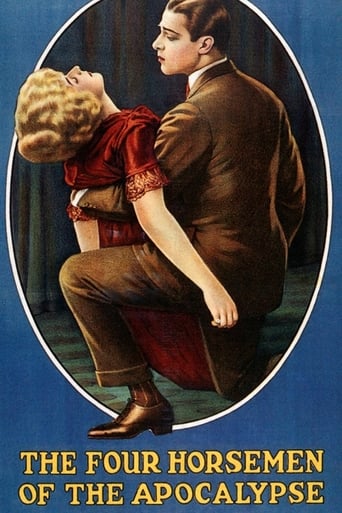
The Four Horsemen of the Apocalypse (1921)
AN EPIC OF REALISM With its great scenes of Argentine-its intimate views of Parisian life-its titanic battle scenes-its massive settings-its tremendous realism-its faithful reproduction of the vital story-its mighty drama-its soul stirring romance.
Set in the years before and during World War I, this epic tale tells the story of a rich Argentine family, one of its two descending branches being half of French heritage, the other being half German. Following the death of the family patriarch, the man's two daughters and their families resettle to France and Germany, respectively. In time the Great War breaks out, putting members of the family on opposing sides.
- Date of release
- 1921-03-06
- TMDB
- 6.6 / 10 (63)
- Runtime
- 2h 36m
- Genres
- War, Romance, Drama
- Director
- Rex Ingram
Casting
- Rudolph Valentino — Julio Desnoyers
- Josef Swickard — Marcelo Desnoyers
- Alice Terry — Marguerite Laurier
- Alan Hale — Karl von Hartrott
- Pomeroy Cannon — Madariaga
- Bridgetta Clark — Doña Luisa
- Virginia Warwick — Chichí
- Mabel Van Buren — Elena
- Stuart Holmes — Otto von Hartrott
- John St. Polis — Etienne Laurier
- Mark Fenton — Senator Lacour
- Derek Ghent — René Lacour
Interesting facts
- Filmed in: Los Angeles
The Four Horsemen of the Apocalypse is a 1921 American silent epic war film produced by Metro Pictures Corporation and directed by Rex Ingram. Based on the 1916 Spanish novel The Four Horsemen of the Apocalypse, by Vicente Blasco Ibáñez, it was adapted for the screen by June Mathis. The film stars Pomeroy Cannon, Josef Swickard, Bridgetta Clark, Rudolph Valentino, Wallace Beery, and Alice Terry.
Production
In 1919, screenwriter June Mathis became head of the scenario department for Metro Pictures. With this position, she became one of the first female executives in film history. Holding a major belief in Spiritualism and the Book of Revelation, Mathis was determined to turn Vicente Blasco Ibáñez's novel The Four Horsemen of the Apocalypse into a film. The book had been a bestseller, but most studios found it impossible to adapt to film.
Mathis's adaptation so impressed the studio that it asked for her input in director and star. For director, she chose Rex Ingram, who would clash with both her and Valentino. Mathis had seen a young actor named Rudolph Valentino in a bit part of a Clara Kimball Young film, Eyes of Youth, in 1919.
Mathis insisted that Valentino would play Julio, but studio executives were nervous with the young actor. Valentino, whose parents were French and Italian, had a distinctly-Latin look that was not used much in pictures at the time. However, Mathis got her way, and after seeing the rushes, she and Ingram decided to expand the role of Julio to showcase the talents of Valentino. Valentino had worked as a taxi dancer during his time in New York.
Alice Terry was cast as Julio's lover, Marguerite. She would marry Ingram that same year.
Metro paid Ibañez $20,000 and 10% of the gross earnings for the rights to adapt his novel. The film took six months to shoot, cost $800,000, and had a cast of 72 "principal players." Valentino was paid only $350 a week, which was much less than other players. To add to his troubles, he also had to provide his own costumes, which cost thousands. The French Marne village was constructed at Griffith Park, in Los Angeles.
Read on Wikipedia · Text from Wikipedia, CC BY-SA 4.0. Data from Wikidata.
Recommended
- The Big Parade 1925 · ★ 7.6
- Suite Française 2015 · ★ 7.2
- Notorious 1946 · ★ 7.7
- Sunshine 1999 · ★ 6.5
- The Zone of Interest 2023 · ★ 7.0
- Legends of the Fall 1994 · ★ 7.4
- The Last Command 1928 · ★ 7.3
- All Quiet on the Western Front 1979 · ★ 6.7
- Where Hands Touch 2018 · ★ 7.9
- Not Easily Broken 2009 · ★ 6.3
- Bonhoeffer: Pastor. Spy. Assassin 2024 · ★ 6.8
- War and Peace 1956 · ★ 6.6