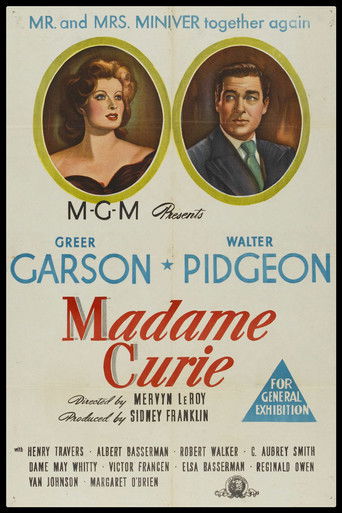
Madame Curie (1943)
MR. and MRS. MINIVER together again
Poor physics student Marie is studying at the Sorbonne in 1890s Paris. One of the few women studying in her field, Marie encounters skepticism concerning her abilities, but is eventually offered a research placement in Pierre Curie's lab. The scientists soon fall in love and embark on a shared quest to extract, from a particular type of rock, a new chemical element they have named radium. However, their research puts them on the brink of professional failure.
- Date of release
- 1943-12-16
- TMDB
- 7.2 / 10 (52)
- Runtime
- 2h 4m
- Genres
- Drama, Romance, History
- Director
- Mervyn LeRoy
Casting
- Greer Garson — Marie Curie
- Walter Pidgeon — Pierre Curie
- Henry Travers — Eugene Curie
- Albert Bassermann — Professor Jean Perot
- Robert Walker — David Le Gros
- C. Aubrey Smith — Lord Kelvin
- May Whitty — Madame Eugene Curie
- Victor Francen — President of University
- Elsa Bassermann — Madame Perot
- Reginald Owen — Dr. Becquerel
- Van Johnson — Reporter
- Margaret O'Brien — Irene Curie - Age 5
Interesting facts
- Based on: Madame Curie
- Awards: 0 · Nominations: 7
Madame Curie is a 1943 American biographical film made by Metro-Goldwyn-Mayer. The film was directed by Mervyn LeRoy and produced by Sidney Franklin from a screenplay by Paul Osborn, Paul H. Rameau, and Aldous Huxley (uncredited), adapted from the biography by Ève Curie. It stars Greer Garson, Walter Pidgeon, with supporting performances by Robert Walker, Henry Travers, and Albert Bassermann.
Production
Universal Studios quickly bought the rights to Ève Curie's book, with Irene Dunne in mind to play Marie. Dunne traveled to Europe and met with Ève Curie to discuss the project, but Universal sold the property to Metro-Goldwyn-Mayer a few years later. In March 1938, Anita Loos contacted Aldous Huxley, then recently moved to Hollywood, saying she would put him in touch with MGM for a writing contract.
MGM's star Joan Crawford was interested in the role Marie as she wanted to play serious characters, but her request was rejected by Mayer. The role went to Greer Garson, and Crawford cited it as a reason to leave MGM and sign to Warner Brothers.
Mervyn LeRoy replaced Albert Lewin, who was fired shortly before production began.
While the film is heavily fictionalized for dramatic purposes, the plot managed to adhere to the facts more than most biopics of the 1930s and 1940s. Madame Curie completely omits any mention of Marie's family in Paris, including her sister Bronisława, an obstetrician, with whom she was very close. There is also virtually no mention of Marie's intense devotion to politics and the liberation/independence of her native Poland.
Author James Hilton was the narrator for this film.
Read on Wikipedia · Text from Wikipedia, CC BY-SA 4.0. Data from Wikidata.
Recommended
- Radioactive 2020 · ★ 6.6
- Mayerling 1968 · ★ 6.2
- Chevalier 2023 · ★ 6.4
- Désirée 1954 · ★ 6.6
- Adventures of a Mathematician 2021 · ★ 6.1
- The Theory of Everything 2014 · ★ 7.8
- Suffragette 2015 · ★ 7.2
- Camille 1936 · ★ 7.0
- Hidden Figures 2016 · ★ 8.1
- Munich - The Edge of War 2021 · ★ 6.9
- Time Is Up 2021 · ★ 6.5
- In Love and War 1996 · ★ 5.9