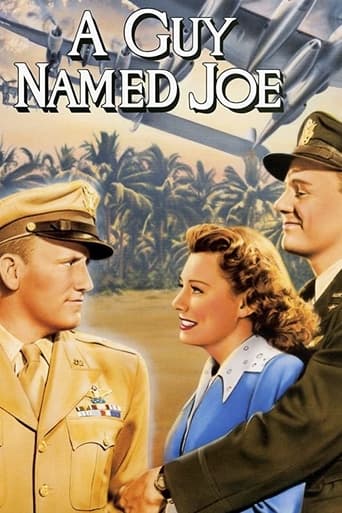
A Guy Named Joe (1944)
A guy—a gal—a pal—it’s swell!
A cocky U.S. Army Air Force pilot stationed in England during World War II falls for a daring female flier. After he's killed on a mission, he's sent back to Earth by a heavenly General with a new assignment.
- Date of release
- 1944-02-25
- TMDB
- 6.7 / 10 (55)
- Runtime
- 2h 0m
- Genres
- Drama, Romance, War, Fantasy
- Director
- Victor Fleming
Casting
- Spencer Tracy — Pete Sandidge
- Irene Dunne — Dorinda Durston
- Van Johnson — Ted Randall
- Ward Bond — Al Yackey
- James Gleason — “Nails” Kilpatrick
- Lionel Barrymore — The General
- Barry Nelson — Dick Rumney
- Esther Williams — Ellen Bright
- Henry O'Neill — Col. Sykes
- Don DeFore — James J. Rourke
- Charles Smith — Sanderson
- Addison Richards — Maj. Corbett
Interesting facts
- Filmed in: South Carolina
- Awards: 0 · Nominations: 1
A Guy Named Joe is a 1943 American supernatural romantic drama film directed by Victor Fleming. The film was produced by Everett Riskin and stars Spencer Tracy, Irene Dunne and Van Johnson. The screenplay, written by Dalton Trumbo and Frederick Hazlitt Brennan, was adapted from a story by Chandler Sprague and David Boehm, for which they were nominated for an Academy Award for Best Writing, Original Story. The film follows dead World War II bomber pilot Pete Sandidge as he becomes the guardian angel of pilot Ted Randall, and helps him romance his old girlfriend.
Production
A Guy Named Joe introduced Van Johnson in his first major role. During filming in 1943, Johnson was seriously injured in an automobile accident. The crash lacerated his forehead and damaged his skull so severely that doctors inserted a plate in his head. Johnson also underwent brain surgery.
During Johnson's period of recovery, Tracy recorded broadcasts for Armed Forces Radio and visited hospitals along the California coast and occasionally appearing at the Hollywood Canteen. Irene Dunne was required to begin work on the MGM film The White Cliffs of Dover, so she performed in both films concurrently after Johnson returned.
Budget restrictions precluded location shooting, and all the flying scenes were staged at the MGM studios. Footage shot at various United States Army Air Forces (USAAF) bases was incorporated using an exterior backdrop process. Authentic aircraft were used, although they remained on the ground.
During the scene in which Tracy's character is killed, he is shown launching a suicidal divebomb run on a German aircraft carrier, but Germany never had an operational aircraft carrier in service during the war. This scene was reportedly initially opposed by the War Department as it conflicted with American war propaganda regarding Japanese kamikaze pilots.
The Production Code Administration objected to the film's ending, which originally depicted Dunne’s character crashing after bombing an enemy ammunition dump, thereby reuniting her with Pete. The censors felt that this represented a willful act of suicide, which, under the Production Code, could never be “justified, or glorified, or used specifically to defeat the ends of justice.” Dunne was recalled from Mexico City to film a revised ending in w…
Read on Wikipedia · Text from Wikipedia, CC BY-SA 4.0. Data from Wikidata.
Recommended
- Air Force 1943 · ★ 6.5
- A Matter of Life and Death 1946 · ★ 7.7
- Always 1989 · ★ 6.2
- Flying Tigers 1942 · ★ 6.3
- The Blue Max 1966 · ★ 6.8
- Wings 1927 · ★ 7.2
- Hell's Angels 1930 · ★ 6.6
- Strategic Air Command 1955 · ★ 6.1
- The Purple Plain 1954 · ★ 6.5
- Battleground 1949 · ★ 6.7
- Racing with the Moon 1984 · ★ 6.3
- The Bridges at Toko-Ri 1954 · ★ 6.0