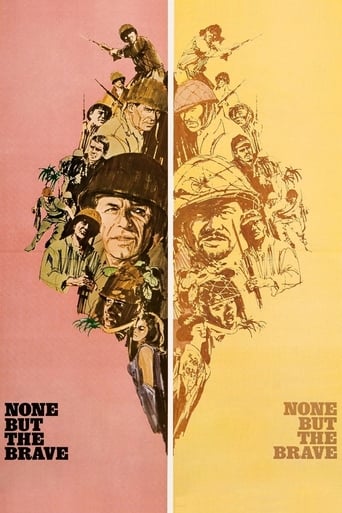
None But the Brave (1965)
The brave are never different - only different looking!
American and Japanese soldiers, stranded on a tiny Pacific island during World War II, must make a temporary truce and cooperate to survive various tribulations. Told through the eyes of the American and Japanese unit commanders, who must deal with an atmosphere of growing distrust and tension between their men.
- Date of release
- 1965-02-24
- TMDB
- 6.4 / 10 (38)
- Runtime
- 1h 46m
- Genres
- War, Drama
- Director
- Frank Sinatra
Casting
- Tatsuya Mihashi — Lt. Kuroki
- Takeshi Katō — Sgt. Tamura
- Homare Suguro — Lance Cpl. Hirano
- Kenji Sahara — Cpl. Fujimoto
- Masahiko Tanimura — Lead Pvt. Ando
- Tōru Ibuki — Pvt. Arikawa
- Ryucho Shunputei — Pvt. Okuda
- Hisao Dazai — Pvt. Tokumaru
- Susumu Kurobe — Pvt. Goro
- Takashi Inagaki — Pvt. Ishi
- Kenichi Hata — Pvt. Sato
- Frank Sinatra — Chief Pharmacist Mate
Interesting facts
None but the Brave is a 1965 anti-war film produced and directed by Frank Sinatra from a screenplay by John Twist and Katsuya Susaki. The film stars Sinatra, Clint Walker, Tommy Sands, Brad Dexter, Tony Bill, and Sammy Jackson as U.S. Marines, and Tatsuya Mihashi, Takeshi Kato, Homare Suguro, Hisao Dazai, Kenji Sahara, and Mashahiko Tanimura as Imperial Japanese soldiers. Stranded on the same uninhabited island during the Pacific War, the two opposing platoons are forced to cooperate to survive.
Production
None but the Brave was initiated in the early 1960s by aspiring Japanese producer Kikumaru Okuda, who developed the original story and co-produced for Tokyo Eiga. The film's title is taken from John Dryden's 1697 poem, Alexander's Feast, stanza 1: "None but the brave/deserves the fair". The script was co-authored by American screenwriter John Twist and Japanese writer Katsuya Susaki, a surviving kamikaze pilot.
Filmmaker Raoul Walsh worked on the script with Twist and initially expected he would direct, encouraged by friends in Japan to film there. On September 3, 1963, the Pittsburgh Post-Gazette reported that filming was scheduled to begin in Japan within weeks under Walsh's direction. However, Twist and Walsh ultimately sold the script to Frank Sinatra. In October, Warner Bros. Pictures president Jack L.
Frank Sinatra took a keen interest in the script after discovering it at Warner Bros. and eventually decided to helm the film himself. In February 1964, it was reported that the film would mark Sinatra's directorial debut. He and executive producer Howard W. Koch traveled to Japan that same month to collaborate with Toho, securing Japanese actors and a special effects crew.
In April–May 1963, Clint Walker entered negotiations to star in the film, marking its initial development announcement and signaling his potential return to Warner Bros. after his seven-year contract with the studio expired. When Walsh was to direct, Troy Donahue, who had recently starred in Walsh's A Distant Trumpet (released in 1964), was attached to appear.
The American cast featured several actors with prior ties to Sinatra. Frank's cousin, Richard Sinatra, appeared in a minor role as a background soldier. Tommy Sands, who played a supporting role, was Sinatra's son-in-law at the time, married to Sinatra's daughter Nancy.
Read on Wikipedia · Text from Wikipedia, CC BY-SA 4.0. Data from Wikidata.
Recommended
- Too Late the Hero 1970 · ★ 6.4
- Flags of Our Fathers 2006 · ★ 6.9
- Tora! Tora! Tora! 1970 · ★ 7.2
- Hell in the Pacific 1968 · ★ 7.0
- The Thin Red Line 1998 · ★ 7.4
- Farewell to the King 1989 · ★ 6.0
- Letters from Iwo Jima 2006 · ★ 7.5
- Men in War 1957 · ★ 6.6
- King Rat 1965 · ★ 7.1
- Cross of Iron 1977 · ★ 7.1
- The Great Raid 2005 · ★ 6.6
- The Beast of War 1988 · ★ 7.1