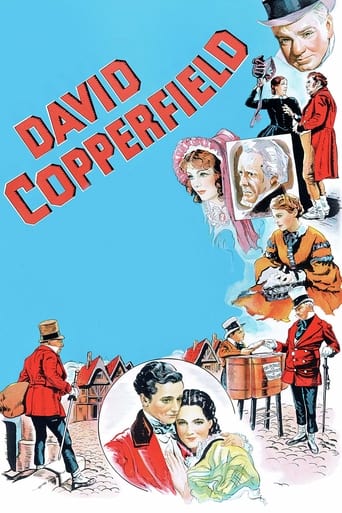
David Copperfield (1935)
The Personal History, Adventures, Experience, & Observation of David Copperfield the Younger
1935's most beloved motion picture!
A young man journeys from a difficult childhood to maturity, exploring social injustice, personal development, and the complexities of human relationships.
- Date of release
- 1935-01-18
- TMDB
- 6.7 / 10 (83)
- Runtime
- 2h 10m
- Genres
- Drama, Romance, Adventure
- Director
- George Cukor
Casting
- Freddie Bartholomew — David Copperfield as a Boy
- Frank Lawton — David Copperfield as a Man
- Edna May Oliver — Aunt Betsey Trotwood
- Jessie Ralph — Clara Peggotty
- Madge Evans — Agnes Wickfield as a Woman
- Maureen O'Sullivan — Dora Spenlow
- Elizabeth Allan — Clara Copperfield
- Harry Beresford — Dr. Chillip
- Hugh Walpole — The Vicar
- Basil Rathbone — Mr. Edward Murdstone
- Herbert Mundin — Barkis
- John Buckler — Ham Peggotty
Interesting facts
- Based on: David Copperfield
- Filmed in: Malibu
- Awards: 1 · Nominations: 2. Including: National Board of Review: Top Ten Films
David Copperfield is a 1935 American film released by Metro-Goldwyn-Mayer based upon Charles Dickens' 1850 novel The Personal History, Adventures, Experience, & Observation of David Copperfield the Younger.
Production
David O. Selznick dearly wanted to film David Copperfield, as his Russian father, Lewis J. Selznick, had learned English through it, and read it to his sons every night. After failing to dissuade Selznick from the project, Louis B. Mayer, his father-in-law and employer, agreed that MGM would underwrite the production provided his contract child star Jackie Cooper was cast in the role of the young David.
Cedric Gibbons designed a recreation of 19th-century London on the MGM backlot. The scenes set outside Aunt Betsey's house atop the white cliffs of Dover were filmed at Malibu. MGM even filmed the exterior of Canterbury Cathedral, which only appears in the film for less than a minute. Special effects, including many matte shots, were by Slavko Vorkapić.
Charles Laughton was originally cast in the role of Mr. Micawber, and was authentically made up with a bald cap, since Dickens describes the character as hairless. After two days' work, he disliked his performance in the dailies and asked to be replaced. Selznick released Laughton, with the project five weeks into production.
"Billed as a super-production, it had all the earmarks of super-flop," reported Silver Screen in 1935: "Cukor decided, 'We must have a good utility man to build the picture up. Someone who can be depended upon to give a surefire performance.'" Laughton recommended comedian and Dickens aficionado W. C. Fields for the part. This proved a wise suggestion.
A clause in Fields's contract stated that he had to play the part with a British accent, but he had difficulty learning the character's florid dialogue and had to read off cue cards. He thus speaks in his own voice, without any affected accent.
Read on Wikipedia · Text from Wikipedia, CC BY-SA 4.0. Data from Wikidata.
Recommended
- Great Expectations 1946 · ★ 7.3
- Pride & Prejudice 2005 · ★ 8.1
- Wuthering Heights 1970 · ★ 6.4
- I Capture the Castle 2003 · ★ 6.7
- Nicholas Nickleby 2002 · ★ 6.8
- Jane Eyre 1996 · ★ 6.9
- The Secret of Moonacre 2009 · ★ 6.6
- Wuthering Heights 1939 · ★ 7.2
- Sense and Sensibility 1995 · ★ 7.4
- Sense and Sensibility 2026 · ★ 7.2
- Jane Eyre 1943 · ★ 6.9
- Kings Row 1942 · ★ 7.3