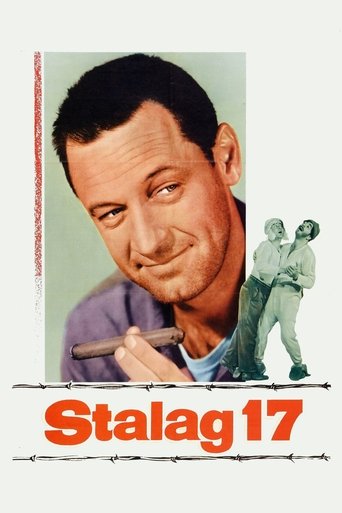
Stalag 17 (1953)
The star-spangled, laugh-loaded salute to our P.W. heroes!
After two American prisoners are killed by guards in the act of escaping from a German POW camp in World War II, barracks black marketeer J.J. Sefton is suspected of being an informer.
- Date of release
- 1953-05-29
- TMDB
- 7.7 / 10 (705)
- Runtime
- 2h 0m
- Genres
- Comedy, Drama, War
- Director
- Billy Wilder
Casting
- William Holden — J.J. Sefton
- Don Taylor — James Dunbar
- Otto Preminger — Oberst von Scherbach
- Robert Strauss — Stanislaus 'Animal' Kuzawa
- Harvey Lembeck — Harry Shapiro
- Richard Erdman — Hoffy Hoffman
- Peter Graves — Frank Price
- Neville Brand — Duke
- Sig Ruman — Johann Schulz
- Michael Moore — Manfredi
- Peter Baldwin — Johnson
- Robinson Stone — Joey
Interesting facts
- Budget: $1.7M
- Based on: Stalag 17
- Filmed in: Woodland Hills
- Awards: 2 · Nominations: 3. Including: Academy Award for Best Actor; National Board of Review: Top Ten Films
Stalag 17 is a 1953 American war comedy film directed and produced by Billy Wilder, from a screenplay by Edwin Blum and Wilder, based upon the Broadway play of the same name by Donald Bevan and Edmund Trzcinski, inspired by their experiences as prisoners in Stalag 17B in Austria. The film follows the story of a group of American airmen confined in a German prisoner-of-war camp. The film focuses on one particular barracks, where the men come to suspect that one of their number is an informant.
Production
The film was adapted by Wilder and Edwin Blum from the Broadway play by Donald Bevan and Edmund Trzcinski, which was based on their experiences as prisoners in Stalag 17B in Austria. Trzcinski appears in the film as a prisoner. The Sefton character was loosely based on Joe Palazzo, a flyer in Trzcinski's prisoner-of-war barracks.
The play was produced and directed by José Ferrer. It was first presented at the Edwin Burke Memorial Theater of The Lambs, a theatrical club, on March 11, 1951 (staged by the authors). It began its Broadway run on May 8, 1951, at the 48th Street Theatre and continued for 472 performances, closing on June 21, 1952.
Both Charlton Heston and Kirk Douglas were considered for the role of Sefton.
The prison camp set was built on the John Show Ranch in Woodland Hills, on the southwestern edge of the San Fernando Valley. The shoot began in February 1952, during the rainy season in California, providing plenty of mud for the camp compound. It is now the location of a meetinghouse of the Church of Jesus Christ of Latter-day Saints.
The film was shot in chronological order, an unusual practice which is usually much more expensive and time-consuming. In a featurette released later, cast members said they did not know the informant's identity until the last three days of shooting.
Read on Wikipedia · Text from Wikipedia, CC BY-SA 4.0. Data from Wikidata.
Recommended
- The Secret of Santa Vittoria 1970 · ★ 6.9
- Walking with the Enemy 2014 · ★ 6.3
- The Kill Team 2019 · ★ 6.5
- Attack 1956 · ★ 6.8
- Battleground 1949 · ★ 6.7
- Field of Lost Shoes 2015 · ★ 6.1
- The Catcher Was a Spy 2018 · ★ 6.2
- Resistance 2020 · ★ 7.0
- Biloxi Blues 1988 · ★ 6.3
- Schindler's List 1993 · ★ 8.6
- The Big Red One 1980 · ★ 6.7
- Inglourious Basterds 2009 · ★ 8.2