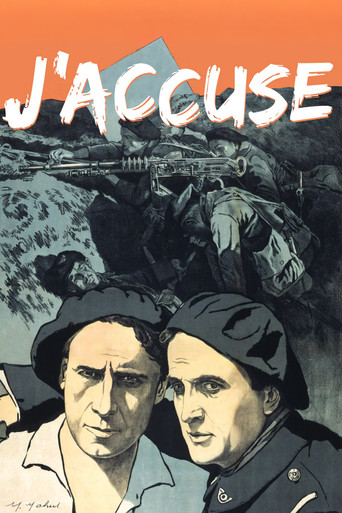
J'accuse (1919)
The story of two men, one married, the other the lover of the other's wife, who meet in the trenches of the First World War, and how their tale becomes a microcosm for the horrors of war.
- Date of release
- 1919-04-25
- TMDB
- 7.4 / 10 (70)
- Runtime
- 2h 45m
- Genres
- War, Drama
- Director
- Abel Gance
Casting
- Romuald Joubé — Jean Diaz
- Séverin-Mars — François Laurin
- Maryse Dauvray — Edith Laurin
- Maxime Desjardins — Maria Lazare
- Angèle Guys — Angèle
- Mancini — Jean's Mother (uncredited)
- Elizabeth Nizan — (uncredited)
- Pierre Danis — (uncredited)
- Paul Duc — Orphan (uncredited)
Interesting facts
J'accuse is a 1919 French silent film directed by Abel Gance. It juxtaposes a romantic drama with the background of the horrors of World War I, and it is sometimes described as a pacifist or anti-war film. Work on the film began in 1918, and some scenes were filmed on real battlefields. The film's powerful depiction of wartime suffering, particularly its climactic sequence of the "return of the dead", made it an international success and confirmed Gance as one of the most important directors in Europe.
Production
Abel Gance had been drafted into the French Army's Section Cinématographique during World War I, but he was later discharged because of ill health, a piece of good fortune to which he later said he owed his life. He had already formulated the idea for J'accuse.
The sequence of the "return of the dead" at the end of the film was shot in the south of France by using 2000 soldiers who had come back on leave. Gance recalled: "The conditions in which we filmed were profoundly moving.... These men had come straight from the Front – from Verdun – and they were due back eight days later.
For the film's opening title, a large group of soldiers, filmed from above, is formed up to shape the letters J...A...C...C...U...S...E. In the middle of preparing the shot, a general asked Gance what was happening. Gance stalled until the shot was complete and then explained to the startled general that he was "accusing the war... accusing men...
Asked whether he regarded J'accuse was a pacifist film, Gance replied: "I'm not interested in politics.... But I am against war, because war is futile. Ten or twenty years afterward, one reflects that millions have died and all for nothing.
The technical quality of the film was impressive, especially the cinematography of Léonce-Henri Burel with its subtle use of lighting effects and a mobile camera. For the battle scenes in the last section of the film Gance also introduced some of the techniques of rapid editing which he would develop much further in his later films La Roue and Napoléon.
Read on Wikipedia · Text from Wikipedia, CC BY-SA 4.0. Data from Wikidata.
Recommended
- The War Below 2021 · ★ 6.6
- Wooden Crosses 1932 · ★ 7.1
- The One That Got Away 1957 · ★ 6.8
- The Last Rifleman 2023 · ★ 6.6
- Waiting for Anya 2020 · ★ 6.3
- Chouans ! 1988 · ★ 5.8
- The Birth of a Nation 1915 · ★ 5.9
- One of Our Aircraft Is Missing 1942 · ★ 6.6
- Life and Nothing But 1989 · ★ 7.2
- Battleground 1949 · ★ 6.7
- Paths of Glory 1957 · ★ 8.3
- Sergeant York 1941 · ★ 7.2