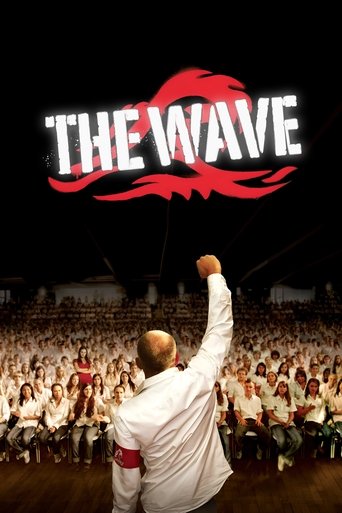
The Wave (2008)
Die Welle
Their teacher became their leader. His students became his soldiers.
A school teacher discusses types of government with his class. His students find it too boring to repeatedly go over national socialism and believe that dictatorship cannot be established in modern Germany. He starts an experiment to show how easily the masses can become manipulated.
- Date of release
- 2008-03-13
- TMDB
- 7.5 / 10 (3750)
- Runtime
- 1h 47m
- Genres
- Drama, Thriller
- Director
- Dennis Gansel
Casting
- Jürgen Vogel — Rainer Wenger
- Frederick Lau — Tim
- Max Riemelt — Marco
- Jennifer Ulrich — Karo
- Christiane Paul — Anke Wenger
- Elyas M'Barek — Sinan
- Cristina do Rego — Lisa
- Jacob Matschenz — Dennis
- Maximilian Vollmar — Bomber
- Tim Oliver Schultz — Jens
- Amelie Kiefer — Mona
- Max Mauff — Kevin
Interesting facts
- Budget: €5M
- Based on: The Wave and The Third Wave
- Awards: 0 · Nominations: 2
The Wave is a 2008 German socio-political thriller film directed by Dennis Gansel and starring Jürgen Vogel, Frederick Lau, Jennifer Ulrich and Max Riemelt in the leads. It is based on Ron Jones' social experiment The Third Wave and Todd Strasser's novel The Wave. The film was produced by Christian Becker for Rat Pack Filmproduktion. Receiving positive reviews from critics, the film was successful in German cinemas, and 2.3 million people watched it in the first ten weeks after its release.
Background
The Wave is not the only movie to convert a social experiment conducted in the United States into a fictionalized plot. The Stanford prison experiment of 1971 was adapted for the 2001 production Das Experiment by Oliver Hirschbiegel, and the 2015 production directed by Kyle Patrick Alvarez, The Stanford Prison Experiment. Gansel's Wave is based on teacher Ron Jones's "Third Wave" experiment, which took place at a Californian school in 1967.
In 1976, Jones published a narrative based on those experiences titled The Third Wave, which was made into a television movie of the same title in 1981. In the same year, author Todd Strasser, writing under the pen-name "Morton Rhue", published his book "The Wave" (a novelization of the television movie), which was published in Germany in 1984 and has since enjoyed great success as a school literature text.
The screenplay is based on an article written by Ron Jones in which he talks about the experiment and how he remembers it. The rights to the story which belonged to Sony were given over to Dennis Gansel for the production of a German movie. As a consequence, Todd Strasser, whose novel popularized the material in Germany, and the publisher Ravensburg, did not receive direct revenues from the film project.
Gansel explained that he did not intend to reenact Jones’ experiment, but rather show how it would be carried out in present-day Germany. He said the movie is not an adaption and that he changed characters, dialogues as well as the beginning and ending of the movie.
According to Gansel, representatives of the Bavarian film-funding agency which were initially inquired to fund the film project declined because they compared it to Strasser's novel. Furthermore, they criticized that the teacher lacked a clear anti-authoritarian position in the submitted script. The entire project was jeopardized and the first film-funding agency to grant financial aid was the Medienboard Berlin-Brandenburg.
Read on Wikipedia · Text from Wikipedia, CC BY-SA 4.0. Data from Wikidata.
Recommended
- Land of the Blind 2006 · ★ 5.8
- A Dry White Season 1989 · ★ 6.6
- Equilibrium 2002 · ★ 7.1
- The Lords of Discipline 1983 · ★ 6.6
- Closet Land 1991 · ★ 6.7
- 6 Underground 2019 · ★ 6.3
- Punishment Park 1971 · ★ 7.3
- Steve 2025 · ★ 6.3
- One Eight Seven 1997 · ★ 6.7
- Child's Play 1972 · ★ 6.1
- Luce 2019 · ★ 6.4
- Nineteen Eighty-Four 1984 · ★ 6.8