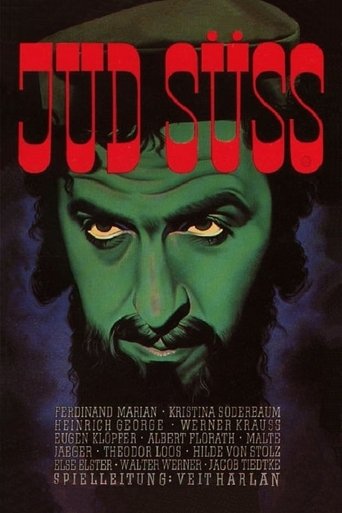
Süss, the Jew (1940)
Jud Süß
Nazi historical drama about Duke Karl Alexander of Württemberg and his treasurer Süß Oppenheimer.
- Date of release
- 1940-09-24
- TMDB
- 4.4 / 10 (46)
- Runtime
- 1h 35m
- Genres
- Drama, History
- Director
- Veit Harlan
Casting
- Ferdinand Marian — Joseph Süß Oppenheimer
- Werner Krauss — Rabbi Loew
- Heinrich George — Karl Alexander, Herzog von Württemberg
- Kristina Söderbaum — Dorothea Sturm
- Eugen Klöpfer — Landschaftskonsulent Sturm
- Hilde von Stolz — Herzogin von Württemberg
- Albert Florath — Obrist Röder
- Malte Jaeger — Aktuar Karl Faber
- Theodor Loos — von Remchingen
- Jakob Tiedtke — Konsistorialrat
- Walter Werner — Herr Fiebelkorn
- Erna Morena — Frau des Konsistorialrats
Interesting facts
- Based on: Jud Süß
Jud Süß is a 1940 Nazi German historical drama/propaganda film produced by Terra Film at the behest of Joseph Goebbels. Considered one of the most antisemitic films of all time, the film was directed by Veit Harlan, who co-wrote the screenplay with Eberhard Wolfgang Möller and Ludwig Metzger. It stars Ferdinand Marian and Kristina Söderbaum with Werner Krauss and Heinrich George in key supporting roles.
Production
Adolf Hitler and the Propaganda minister Joseph Goebbels believed that film was a very potent tool for molding public opinion. The Nazi Party first established a film department in 1930 and Goebbels had taken a personal interest in the use of film to promote the Nazi philosophy and agenda.
According to Richard Levy, "Of the 1,100 feature films produced under the Nazis, only a handful demonstrated explicit antisemitic content and even there, the antisemitism was often secondary to the film's plot. ... Two films, however, both produced in 1940, were designed to translate National Socialism's antisemitic ideology to a popular audience: Der ewige Jude (The Eternal Jew, 1940) and Jud Süß (Jew Süß, 1940)."
In November 1938, Goebbels made a series of attacks against the Jews in the German media that, after the murder of a German diplomat in Paris by a Jew, resulted in the anti-Jewish riots known as Kristallnacht. Kristallnacht was considered by Hitler to have been a political disaster both within Germany and internationally, and he became furious with Goebbels.
In response to Hitler's reprimand, Goebbels launched a campaign to promote the antisemitic views of the Nazis to the German populace. He ordered each film studio to make an antisemitic film. Hitler preferred films such as Der ewige Jude which presented the Nazi antisemitic agenda openly and directly; however Goebbels disliked the crudeness of such straight-forward approaches, preferring the much more subtle approach of couching antisemitic messag…
Although Goebbels did not usually have an active role in the production of particular films, he elected to do so in the case of major propaganda films such as Jud Süß. Saul Friedländer suggests that Goebbels' intent was to counter three films whose messages attacked the persecution of Jews throughout history by producing antisemitic versions of those films with identical titles.
Read on Wikipedia · Text from Wikipedia, CC BY-SA 4.0. Data from Wikidata.
Recommended
- Origin 2023 · ★ 6.2
- The Monuments Men 2014 · ★ 6.1
- The People vs. Fritz Bauer 2015 · ★ 6.8
- The Pawnbroker 1965 · ★ 7.1
- The Boy in the Woods 2023 · ★ 7.0
- RKO 281 1999 · ★ 6.5
- Julia 1977 · ★ 6.5
- Apt Pupil 1998 · ★ 6.5
- Schindler's List 1993 · ★ 8.6
- Nuremberg 2025 · ★ 7.6
- Truth & Treason 2025 · ★ 8.1
- Ararat 2002 · ★ 6.1