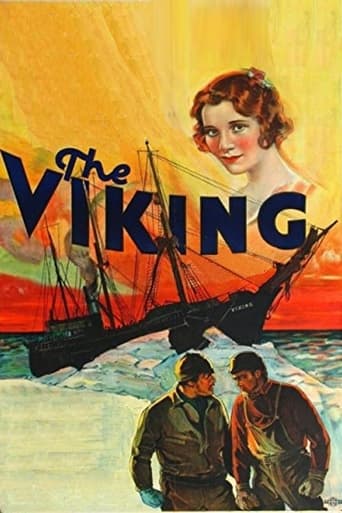
The Viking (1931)
Actually produced during the Great Newfoundland Seal Hunt and You see the REAL thing
Originally called White Thunder, American producer Varick Frissell's 1931 film was inspired by his love for the Canadian Arctic Circle. Set in a beautifully black-and-white filmed Newfoundland, it is the story of a rivalry between two seal hunters that plays out on the ice floes during a hunt. Unsatisfied with the first cut, Frissell arranged for the crew to accompany an actual Newfoundland seal hunt on The SS Viking, on which an explosion of dynamite (carried regularly at the time on Arctic ships to combat ice jams) killed many members of the crew, including Frissell. The film was renamed in honor of the dead.
- Date of release
- 1931-03-05
- TMDB
- 5.3 / 10 (8)
- Runtime
- 1h 10m
- Genres
- Action, Drama, Romance, Adventure
- Director
- George Melford, Varick Frissell
Casting
- Charles Starrett — Luke Oarum
- Louise Huntington — Mary Joe
- Arthur Vinton — Jed Nelson
- Bob Bartlett — Captain Barker (as Captain Bob Bartlett)
- Wilfred Grenfell — Prologue Speaker
Interesting facts
The Viking, also known as White Thunder and Vikings of the Ice Field, is a 1931 Newfoundland/American adventure film about sealing directed by George Melford. The Viking was the first film to record sound and dialogue on location, with the use of magnetic wire recording. It is best known for the explosion aboard the ship SS Viking during filming, in which many members of the crew, including producer Varick Frissell, were killed. It remains the incident with the largest loss of life in film history.
Production
American-born producer Varick Frissell's previous short films, The Lure of Labrador and The Swilin' Racket (also known as The Great Arctic Seal Hunt), prompted him to make a full-length feature entitled Vikings of the Ice Field. Paramount Pictures put up $100,000 to finance the production, while insisting that Hollywood personnel be used.
By 1930, Frissell had completed most of the principal photography on location in Quidi Vidi. For realistic footage, Frissell then took his crew to the Grand Banks and Labrador to film action sequences. The film was privately shown at the Nickel Theatre at St. John's on March 5, 1931. After this screening, Frissell decided that his film needed more real scenes from the Labrador ice floes.
On March 15, 1931, while trying to film an iceberg, Frissell, Alexander Penrod, 25 crew members and a stowaway were killed in an explosion. Some of the survivors made the over-ice trek to the Horse Islands, while others were rescued by vessels dispatched to the area.
Despite the fatal accident, the film was completed and released in June 1931. The title was changed from White Thunder to The Viking. A French-language version Ceux du Viking was released in 1932.
Read on Wikipedia · Text from Wikipedia, CC BY-SA 4.0. Data from Wikidata.
Recommended
- Supercross 2005 · ★ 6.3
- Sahara 1983 · ★ 5.9
- True Grit 1969 · ★ 7.3
- Eight Below 2006 · ★ 7.0
- Primal: Tales of Savagery 2019 · ★ 8.4
- The Black Pirate 1926 · ★ 6.7
- Hell and High Water 1954 · ★ 6.0
- Battleground 1949 · ★ 6.7
- Benji 2018 · ★ 6.9
- Babylon 5: The Legend of the Rangers - To Live and Die in Starlight 2002 · ★ 6.0
- When I'm Ready 2025 · ★ 6.4
- Jack Hunter and the Lost Treasure of Ugarit 2010 · ★ 6.5